Google has quietly rewired how people will buy online, and if you run an ecommerce store, it changes the game for you too.
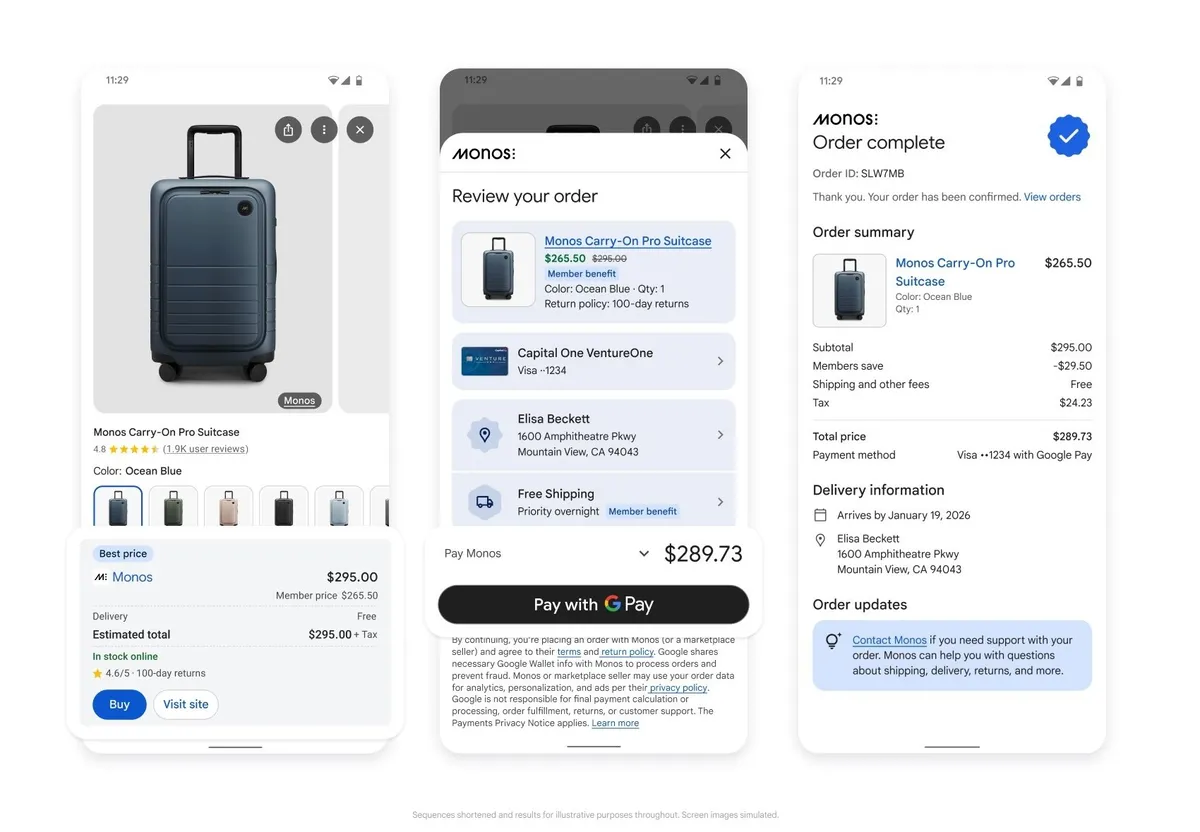
In January 2026, at the National Retail Federation conference, Google announced the Universal Commerce Protocol (UCP): an open standard that lets shoppers discover, compare, and buy products directly inside Google’s AI experiences, including AI Mode in Google Search and the Gemini app, without clicking through to a retailer’s website.
The customer researches a product, an AI agent finds the best match, and the purchase completes right there in the conversation, paid through Google Pay with details already saved in Google Wallet. There’s no landing page, no cart page, and none of the complex checkout flows we’re used to.
What’s different about Universal Commerce Protocol?

Google didn’t build UCP alone. It co-developed the protocol with Shopify, Etsy, Wayfair, Target, and Walmart, and more than 20 industry leaders have endorsed it since, including payment providers like Visa, Mastercard, Stripe, American Express, and PayPal.
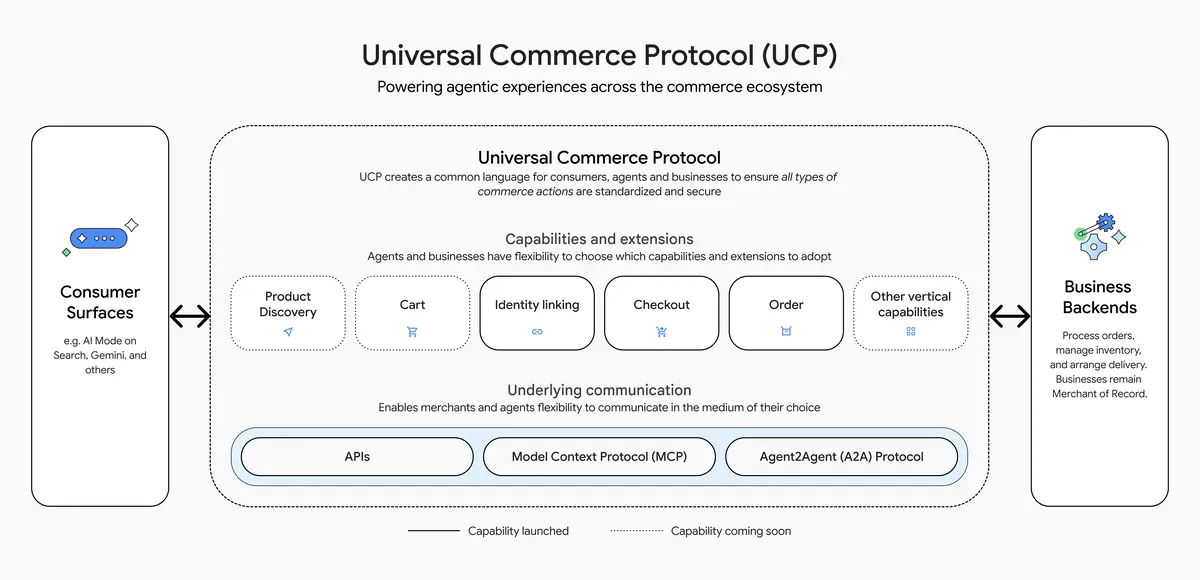
UCP is an open source standard designed to work alongside existing agent frameworks such as Anthropic’s Model Context Protocol and Google’s own Agent Payments Protocol (AP2). It’s shaping up as a common language for the entire commerce ecosystem, one that other AI platforms and AI tools can plug into rather than compete against.
Since launch, Google has moved quickly. The protocol now supports multi-item carts, real-time product discovery, account linking for loyalty programmes, and order management, so shoppers can check order status without leaving the conversation.
In May, Google introduced the Universal Cart: a single cart that carries across retailers and across Google Search, Gemini, and YouTube, with buy-now-pay-later options through Affirm and Klarna. The checkout feature launched with eligible retailers in the US and is rolling out to Canada and Australia, with the UK to follow. Brands like Nike, Sephora, Ulta Beauty, and Shopify merchants such as Fenty already support native checkout through the protocol.
One point worth stressing for retailers: you remain the seller of record. You keep your customer relationships and your customer data. UCP acts as a pipe connecting your store to where high-intent shoppers increasingly start their research, not a replacement for your business.
Moving from keywords to data
For two decades, ecommerce visibility has largely been a keyword game: bid on the right terms, optimise the right pages, win the click. Agentic commerce works differently.
When a shopper asks an AI agent to find something, for example “a lightweight waterproof jacket under $200 that ships this week”, the agent queries structured product data rather than matching search terms. It looks at attributes, availability, price, delivery promises, and reviews, and returns the products that answer the request most completely.
That shifts the priority for online shopping success from keyword strategy toward data hygiene. Incomplete feeds, missing attributes, stale stock levels, and vague product descriptions won’t just rank poorly, they’ll make you invisible to the agent altogether.
It also opens a more strategic opportunity: multi-dimensional product segmentation. When agents can read rich, well-structured data, you gain more control over which products they surface. You can use business logic within your feed to apply discounts, manage dynamic pricing, and steer AI-driven demand toward the products that protect your margin. Retailers who treat their product feed as a strategic asset instead of an IT chore are likely to come out ahead.
What you should be doing now
The practical foundations are unglamorous but decisive:
Merchant Center
UCP participation runs through Google Merchant Center. If your account is poorly configured, under-verified, or missing the newer AI-focused attributes, you’re not in the race. Google has been steadily simplifying UCP onboarding within Merchant Center, but only for merchants whose house is in order.
Feed completeness
Make sure your feed includes GTINs, full attribute coverage, structured data, and high-quality imagery. Real time pricing and accurate stock levels matter just as much. An agent that gets burned by a wrong price or an out-of-stock item won’t surface you again in a hurry.
Platform readiness
If you’re on Shopify, you’re in a strong position: Shopify co-developed the protocol, and its merchants were among the first live on Universal Cart. Other platforms including Salesforce and Stripe are implementing UCP too, but timelines vary, knowing where your stack sits matters.
The window here is genuinely early. Most retailers haven’t started. The ones who get their data foundations right over the next six to twelve months will be the default answers when AI agents start doing a meaningful share of the buying.
Is your store UCP-ready?
We’re offering a free UCP Readiness Audit — a one-off health check for ecommerce businesses. We’ll review your Merchant Center setup, assess your product feed for completeness (GTINs, attributes, structured data, real-time pricing and stock accuracy), and evaluate your platform’s readiness for agentic commerce, with a clear, prioritised list of what to fix first.
No pressure, no obligation, just a clear picture of where you stand before AI agents start deciding who gets the sale.