Google is making an important change to how Target CPA and Target ROAS campaigns behave when they are limited by budget.
From 17 August 2026, Google Ads will optimise these campaigns more consistently towards the target you have set, even when budget constraints change.
That sounds straightforward, but in practice, it could have a noticeable impact on budget-limited campaigns that are currently performing much better than their stated target suggests they need to.
If your campaign has a target CPA of $10 but is generating conversions for $5, Google’s target bidding changes may start pushing performance closer to $10. You may get more conversions, but you may also pay more for them.
The same applies to target ROAS. If your campaign is set to 400% but consistently achieves 700%, Google may be more willing to trade some of that efficiency for additional conversion value.
The key point is that your bidding target is about to matter more.
What’s changing with target-based bidding strategies?
At the moment, some budget-constrained campaigns can outperform their stated target by a wide margin. That can create a misleading sense of security.
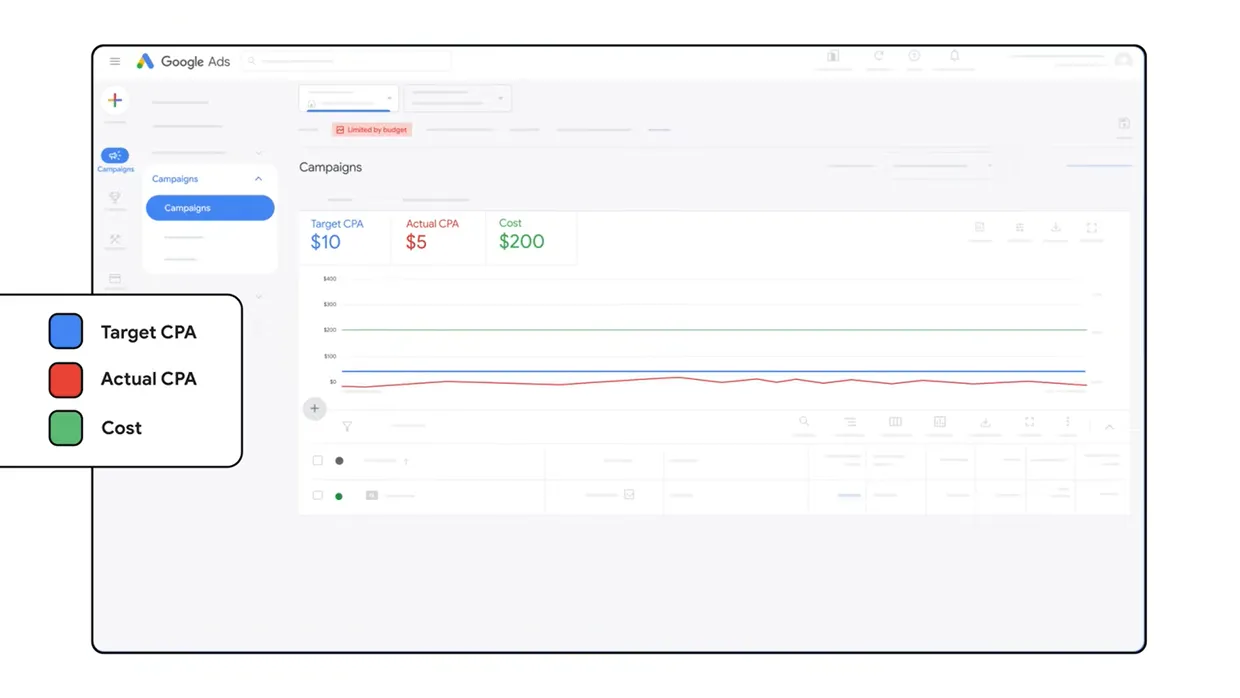
You might see a strong CPA or ROAS, increase the budget, and expect the same level of efficiency to continue. Instead, performance may fluctuate as Google enters more auctions and looks for additional conversion opportunities.
The new bidding target change is designed to make that process more predictable.
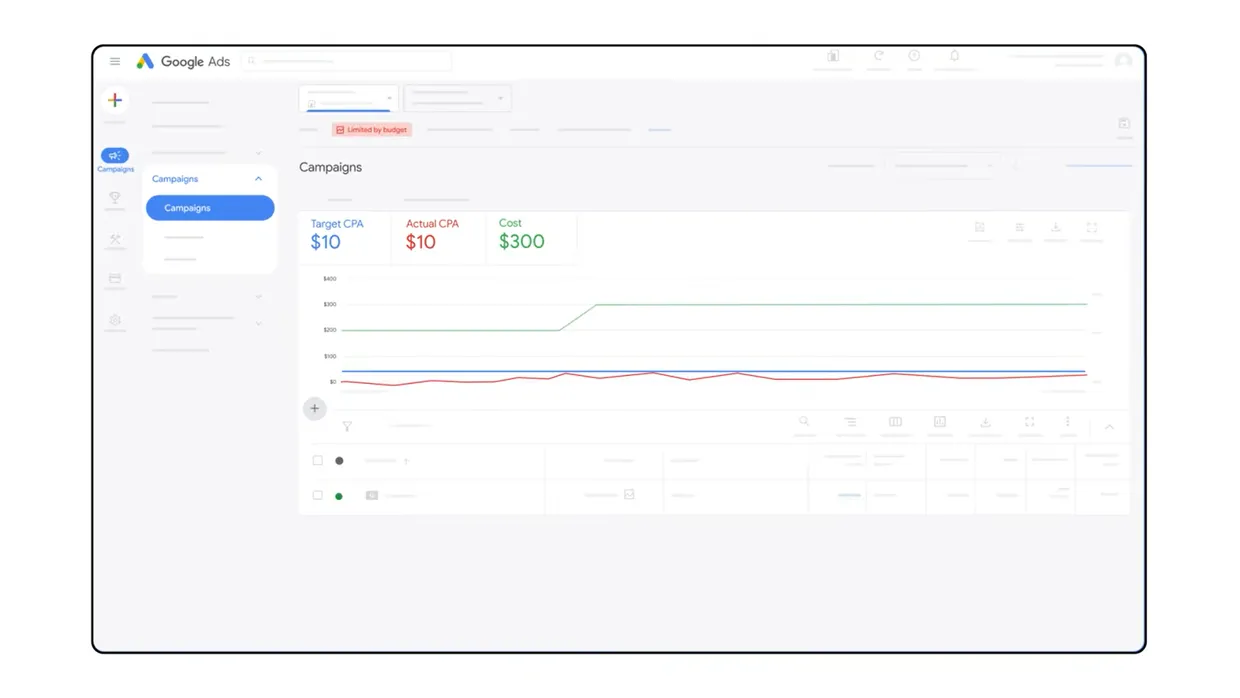
From 17 August, Google will work more consistently towards your target CPA or target ROAS, including after a budget increase. That means a campaign with a $10 target CPA is more likely to behave like a campaign aiming for a $10 CPA, rather than one that happens to keep delivering at $5.
Is this a bad thing?
Not necessarily.
If a lead is worth $10 to your business, generating more leads at an average CPA closer to $10 may be exactly what you want. The campaign may look less efficient compared with recent performance, but your business could be better off if total conversion volume increases.
The issue comes when the target no longer reflects what your business is actually comfortable paying.
Targets are often set when a campaign is new, when conversion data is limited, or when you’re still working out what a lead or sale is worth. Over time, campaign performance improves, but the original target setting stays in place.
That may not have caused an obvious problem before. After this update, it could.
Your bidding target is a business decision
Target CPA and target ROAS are often treated like campaign settings that only the marketing team needs to think about. They’re really commercial decisions.
A target CPA should reflect what your business can afford to pay for a lead, sale, or customer. A target ROAS should reflect the return you need after accounting for margins, fulfillment costs, and other operating expenses.
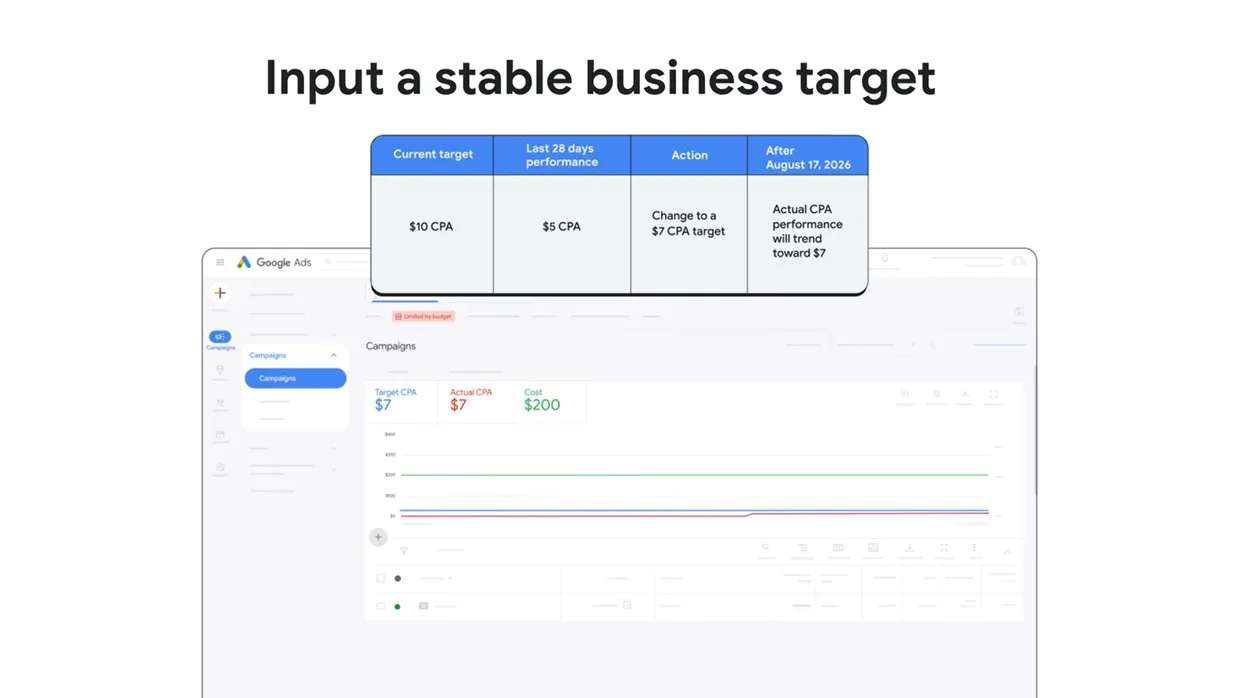
That doesn’t mean the target setting should always match recent performance. A campaign generating leads at $5 may still be highly profitable at $7. In that case, changing the bidding target to $7 could give Google more room to find additional conversions without moving beyond an acceptable cost.
Likewise, a campaign achieving a 700% ROAS may still be commercially successful at 500% if the lower bidding target allows you to generate substantially more revenue.
The best bidding target is not always the tightest one. It is the one that reflects the right balance between efficiency and growth.
What could your new bid strategy look like in practice?
Imagine a campaign with:
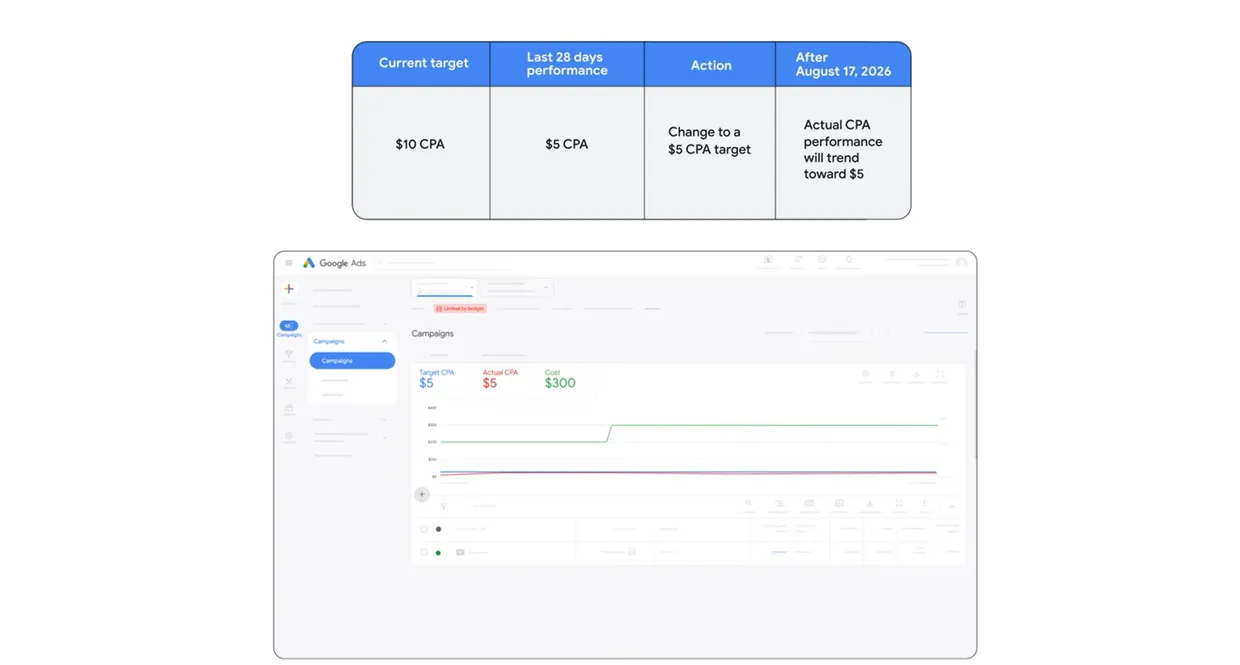
- A target CPA of $10
- A recent actual CPA of $5
- A limited by budget status
There are a couple of ways you could respond:
If you want to protect your current bidding targets and efficiency, you could update bidding targets and lower the target closer to $5.
If a $7 CPA still delivers a strong return, you could modify targets to $7 to create more room for growth.
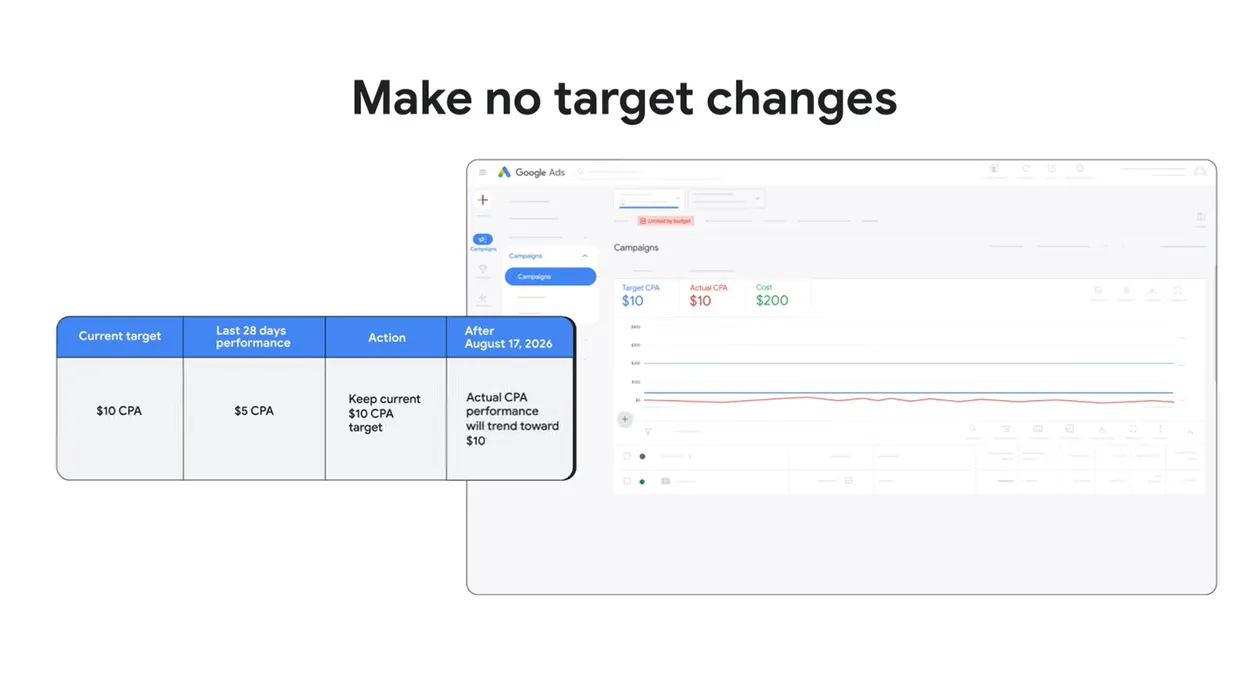
If $10 remains profitable and you want more volume, the existing targets may still be the right choice.
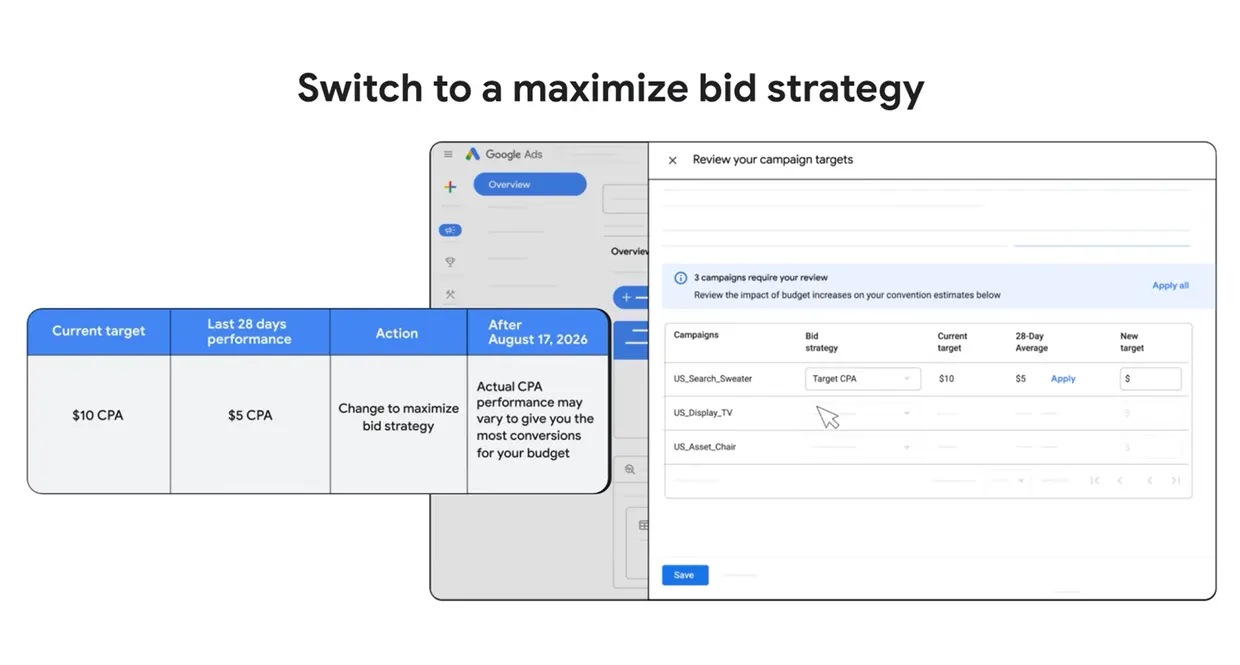
Another option is to remove the target-based bid and use Maximise Conversions or Maximise Conversion Value. This tells Google to generate the highest possible volume or conversion value within the available budget, without working towards a specific CPA or ROAS.
The right answer depends on what you’re trying to achieve.
Why Google is adjusting target-based bidding strategies
The main benefit of this update is more predictable performance when scaling.
Right now, increasing the budget limitation on a campaign significantly outperforming its target can produce uneven results. CPA may rise quickly, ROAS may fall, or campaign performance may take time to stabilise.
Google wants campaigns to behave more consistently when advertisers add budget.
After the update, a campaign should continue operating closer to its configured target as spend increases.
That does not mean current overperformance will be preserved. It means Google will aim to scale towards the performance level you have said is acceptable.
For advertisers, that should make it easier to plan campaign budget, but only when the target itself is right.
Which campaigns are affected?
The update applies to campaign types that are limited by budget and use target CPA or target ROAS:
- Search
- Shopping
- Performance Max
- Demand Gen
- Display
- Travel
The change will also apply across Google Ads, Search Ads 360, Display & Video 360, Google Ads Editor and the Google Ads API.
App campaigns, Video Reach campaigns and Video View campaigns are excluded.
Google has also advised that Performance Max and Demand Gen campaigns may see changes in how traffic is distributed across channels as the system works more consistently towards the selected target.
What should advertisers do before 17 August?
Google won’t automatically change your budgets or bidding targets. What matters now is identifying campaigns that:
- Are limited by budget
- Use target CPA or target ROAS
- Are performing significantly better than their bidding target
- Have not had their bidding target reviewed recently
From there, ask a simple question: does the stated target still reflect what your business wants?
That review should go beyond the figures shown in Google Ads. Lead quality, sale value, profit margin, customer lifetime value, and capacity all matter. A cheaper lead isn’t always better if it limits growth. A higher ROAS isn’t always the best outcome if you’re missing profitable sales.
Google released a new Bid Target Adjustment Tool on 6 July 2026 to help advertisers compare recent performance with current bidding targets and make changes where needed.
The tool identifies the gap. You still need to decide what the right bid strategy should be.