Browser restrictions, privacy tools and ad blockers make it harder to get a complete picture of what people are doing on your website — that matters, because tracking data feeds Google Ads, Google Analytics 4, automated bidding and budget decisions.
When conversions are missed, it becomes harder to know what’s working, and easier to make decisions based on incomplete data.
Google Tag Gateway can help with this problem. It gives you a way to serve Google tags through first-party infrastructure on your own domain, rather than relying on third-party Google domains.
Running Google Ads, GA4 or Google Tag Manager? Learn how Google Tag Gateway could be a practical upgrade for your measurement setup.
What is Google Tag Gateway?
Google Tag Gateway (officially called Google Tag Gateway for advertisers) lets you deploy Google tags using your own first-party infrastructure on your own website domain.
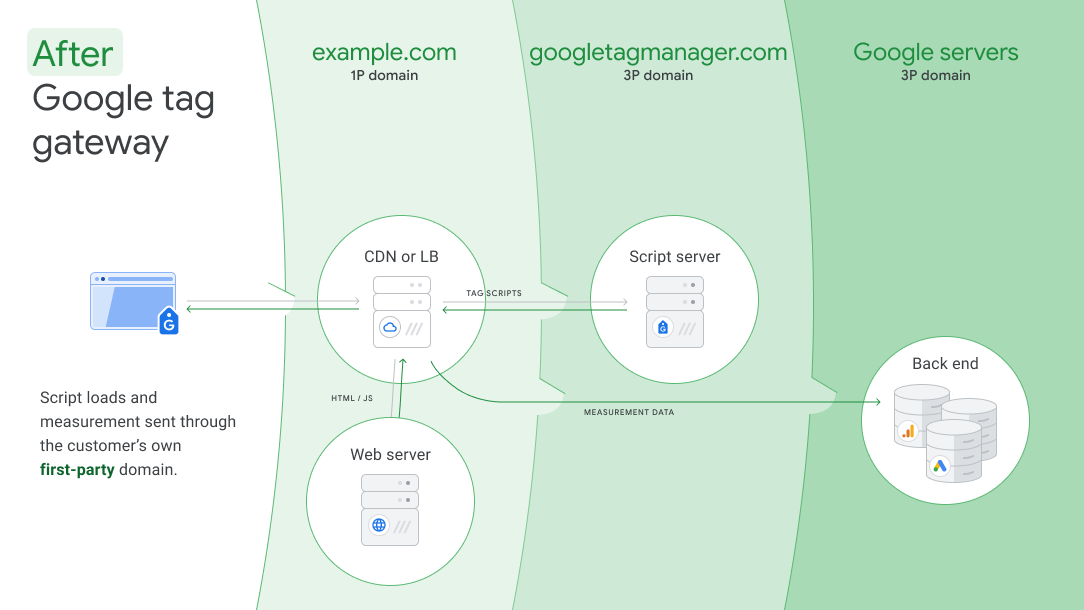
In a standard tracking setup, a website loads the Google tag from a Google domain, and measurement requests are sent directly to Google’s servers. With Google Tag Gateway, the tag can be served through your own domain instead. This puts more of the tag delivery and measurement process into a first-party context.
In plain English, your website’s server becomes part of the way the Google tag is delivered.
That first-party context is the main reason Google Tag Gateway matters. It can make measurement more durable, reduce the impact of some tracking blockers, and give Google Ads and Google Analytics 4 a stronger base of data to work with.
3 reasons to consider Google Tag Gateway
1. Better data for Google Ads
Google Ads relies heavily on conversion signals.
Automated bidding needs to understand which clicks, campaigns and search terms are most likely to drive valuable actions. If conversions are missed or conversion value is under-reported, the platform has less reliable data to learn from, and that flows through to your campaign performance.
Google Tag Gateway can help by serving Google tags through your own domain, rather than relying only on third-party Google domains. This can reduce data loss caused by ad blockers and tracking prevention tools, improving data accuracy.
It won’t recover every lost signal, and it won’t bypass every blocker. But even a partial improvement in measured conversions is valuable when those signals are guiding your budgets, bidding and campaign decisions.
2. A lower-cost first-party measurement upgrade
Another strong reason to consider Google Tag Gateway is that it gives you a lighter path to better first-party measurement.
More advanced server-side tracking platforms can be very useful. They offer more control, more flexibility, and broader options, including non-Google tags and native integrations across different platforms. But they also add hosting costs and extra moving parts that need ongoing management.
Google Tag Gateway is different. It is not a full server-side tracking platform, but it can improve how Google tags are served without turning the project into a larger tracking rebuild.
For many advertisers, that makes it a sensible first step. It keeps the focus on Google Ads and Google Analytics 4, strengthens the measurement foundation, and avoids adding more complexity than is needed.
3. A practical step before full server-side tracking
Server-side tagging can be powerful, but it’s not always the right first move.
A full server-side GTM container setup usually makes sense for businesses with more complex tracking needs, multiple advertising platforms, advanced ecommerce data requirements or stricter data control requirements, such as routing data through European servers for GDPR compliance. But not every advertiser needs to start there.
Google Tag Gateway sits between a standard browser-based tagging setup and a full server-side tagging environment. It gives you a practical first-party measurement improvement without the larger infrastructure build.
What Google Tag Gateway doesn't do
- It won’t automatically fix poor tracking. If conversion actions are set up incorrectly, events are duplicated, ecommerce values are inaccurate or form submissions aren’t firing properly, Google Tag Gateway won’t solve those issues on its own. A clean GTM setup and accurate data streams are still the foundation: Google Tag Gateway improves how tags are delivered, not what they’re measuring.
- It doesn’t bypass every tracking blocker. Some blockers look beyond the domain and inspect the network tab for patterns associated with tracking scripts, so requests via a first-party domain can still be detected and blocked in some cases.
- It doesn’t replace your privacy responsibilities. For most NZ-focused businesses, the key point is usually transparency about how personal information is collected and used, rather than a European-style cookie consent model. If your business targets or tracks users in markets with stricter consent rules, those requirements still apply.
How does Google Tag Gateway actually work?
When you set up Google Tag Gateway, your website’s code is updated so that the GTM script and tag settings load from your own first-party domain rather than a standard Google domain.
Measurement requests from the user’s browser are forwarded to Google through your own server, rather than going directly to Google endpoints. You can set this up directly through your own first-party infrastructure, or via a content delivery network.
The result is that first-party tags operate in a more durable way, with less exposure to the signal loss that affects standard browser-based setups. You get richer data flowing into Google Ads and Google Analytics without needing to migrate to a full server-side environment.
When Google Tag Gateway makes sense
Google Tag Gateway makes the most sense if you rely on Google Ads, Google Analytics 4 or Google Tag Manager and want better measurement without jumping straight into a full server-side tracking project.
I recommend looking at Google Tag Gateway if:
- Your current tracking is mainly browser-based
- Your Google Ads account relies on automated bidding
- You’re concerned about missed conversion data or signal loss
- You want to improve first-party data collection in a practical, cost-effective way
- You’re exploring server-side GTM but aren’t ready for a complete setup yet
Ready to strengthen your tracking?
Google Tag Gateway strengthens the foundation of your Google tracking without requiring a jump straight into a more complex server-side environment. It helps forward requests through your own first-party infrastructure, can reduce the impact of some blockers, and gives Google Ads and Google Analytics richer data to work with.
If you’re running Google Ads and relying on website conversions, Google Tag Gateway is worth reviewing. The question is not just whether your tracking works today. The better question is whether it is durable enough for where measurement is heading.
Would you like to discuss if Google Tag Gateway is right for your website? Get in touch with the Search Republic team and we can help you work out the best approach.