
Google has greatly expanded its preferred sources feature to all languages and locales. This lets users directly influence which publishers appear in current news results and highlights their appearance in AI Mode/AI Overviews.
If you’re a publisher, you can encourage users to set your site as a preferred source on Google, boosting your overall visibility in search results. Luckily, Google has released a couple of assets that let you quickly add a preferred source button to your website.
Learn more about how this new feature works and how to set up a preferred sources button on your site!
What are preferred sources on Google?
Any Google user can set their favourite websites in the preferred sources tool. Sources can be at the domain- or subdomain-level (not paths).
Preferred sources affect the search results page in two ways:
- For current news events, preferred sources are more likely to appear in Top Stories.
- In AI search results (AI Mode and AI Overviews), preferred sources are marked with a ‘preferred’ badge for quick reader identification.
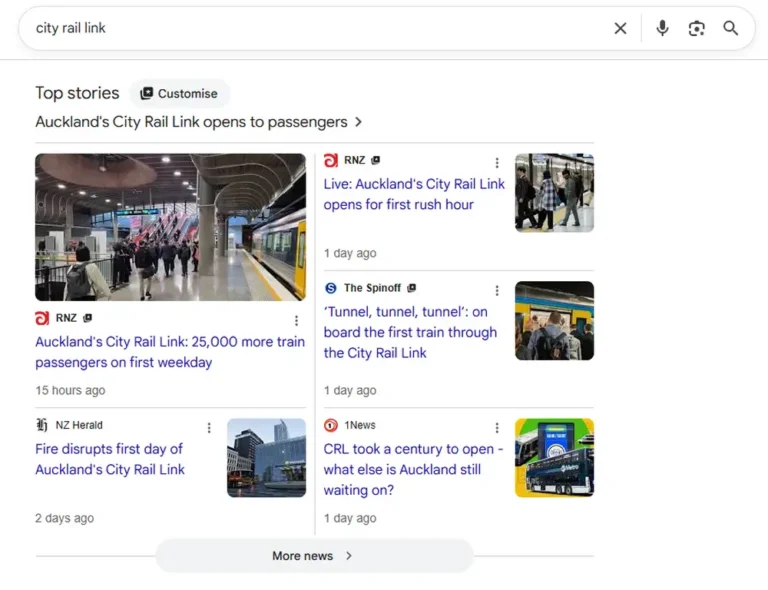
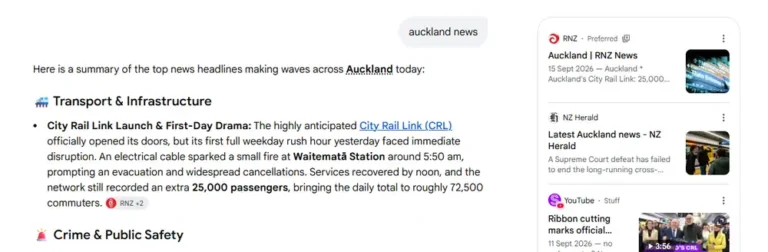
When users set your website as a preferred source, they’re more likely to see your site and click in — Google has even shared that “readers are twice as likely to click through to a site after marking it as a preferred source“. That gives Google a clear signal that users want to see your content, boosting overall SEO visibility.
Who counts as a publisher for Google Search preferred sources?
Users can only select from source preferences listed in the tool. The range of sites available is very broad, and includes plenty of websites that don’t have a blog or news section. So in terms of pure eligibility, any regularly updated website can be a preferred source on Google.
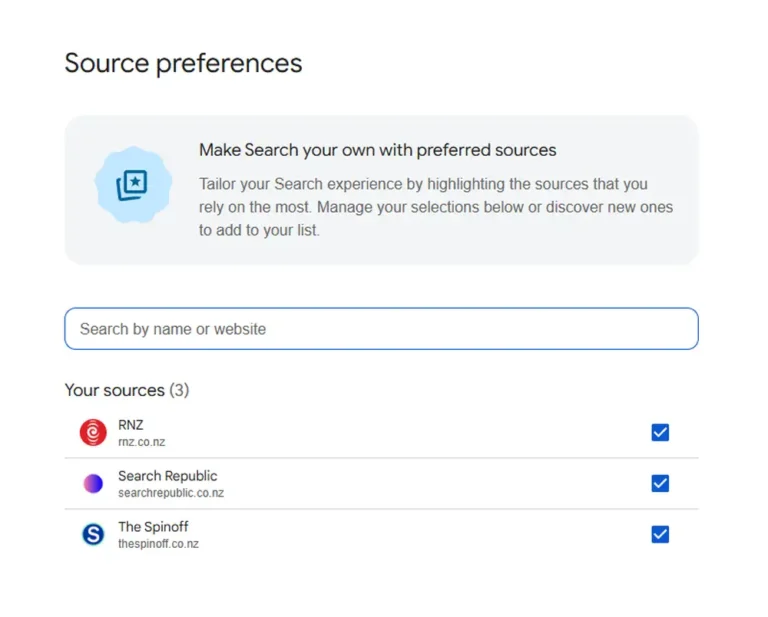
That being said, preferred sources are currently most relevant to news publishers and other websites that report on current events. Websites must meet strict eligibility criteria to appear in Top Stories and Google News, including high levels of EEAT (experience, expertise, authority, and trustworthiness), a consistent history of producing fresh content, and compliance with Google’s News policies.
But even if your site doesn’t appear in Google News, your article links will still be highlighted in AI Mode/AI Overviews with a preferred sources badge. While this doesn’t seem to affect how often the site appears in Google’s AI systems, the badge can help users quickly identify their trusted sources.
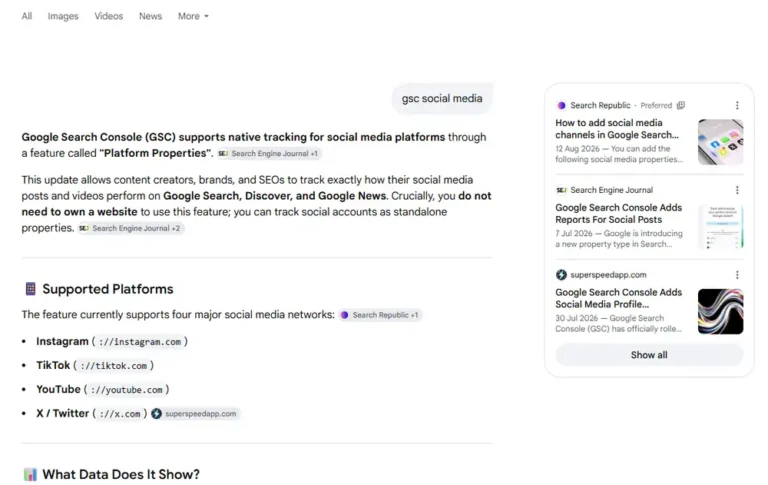
Check out our guide to adding social media channels in Google Search!
How to add a Google preferred source button to your website
Google offers two easy ways to add a preferred source button to your website:
JavaScript preferred sources button
Google recommends implementing the preferred sources button through JavaScript. When users click on the button, your site will be added to their preferred sources list. The user will then be redirected to your site, providing a more seamless reading experience.
To add a JavaScript preferred source button:
- Add this code to the head of your site.
<script async src="https://news.google.com/swg/js/v1/publisher.js"></script>
- Add this code anywhere you want your button to appear on the page.
<div google-add-preferred-source-btn></div>
You can find more information about setting the button theme and language in Google’s documentation.
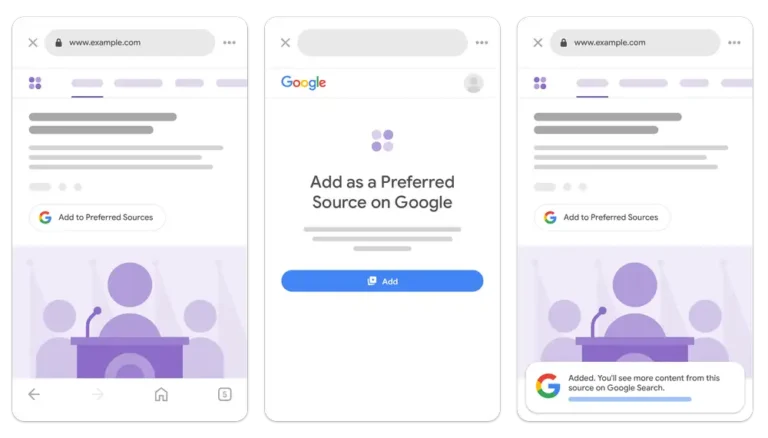
Deeplink/hyperlink preferred sources button
If your CMS doesn’t let you add JavaScript or you want your button to be accessible to readers who block JS, you can add a hyperlink button instead. To do this:
- Get your preferred source URL by replacing Your_Website’s_URL with your domain name.
https://www.google.com/preferences/source?q=Your_Website's_URL
- Download Google’s button assets.
- Upload the button image and link it with your preferred source URL.

How can Google preferred sources help with search marketing?
Increased visibility in Google AI systems and search results
SEO has a bit of a snowball effect, where a well-performing page can increase your site’s overall visibility in search results. That means that users are more likely to click through to your website, with the effect compounding over time. It’s what makes content marketing such an effective digital marketing strategy, even if ‘content creation’ isn’t your main business model (if you run an e-commerce or service website, for example).
Google has long personalised search results based on user location and history, but this change lets users influence their search results much more directly. By encouraging users to add your site as a preferred source, you can help ‘get the ball rolling’ SEO-wise.
Every click into your site tells Google that your website is valuable to visitors, increasing your search visibility even for users who haven’t set source preferences or logged in. If you’re a current news publisher, you’ll want to hop on this as soon as possible!
Greater publisher control
Preferred sources is just one of the new publisher-focused features Google has recently added, giving original content creators more control over their work (we previously mentioned Search profiles in our guide to checking your website’s performance in Google’s AI features).
More recently, as of September 2026, Google has been testing a pay-per-value AI licensing program for publishers. If publishers join the program, they can earn revenue when Google ‘significantly’ uses their content for Gemini, AI Mode, and AI Overviews.
The revenue is based on how Google judges the content’s ‘value’ rather than usage, so you probably wouldn’t earn more just because many people set your site as a preferred source. However, Google is still working out how to calculate ‘value’, so time will tell how the programme plays out.
What’s next for preferred sources on Google?
While preferred sources is mainly relevant for current news sites, it could also signal what’s to come. Some fringe search engines, like Kagi, let users block or promote particular sites, tailoring the search results to their interests. If Google takes a similar approach, preferred sources could become more important in the future.
Stay in the know with SEO through Search Republic
No matter what type of website you run, it’s good to know what’s going on with Google’s preferred sources. To stay up to date on Google Search news, check out our digital marketing blog and RSS feed, or sign up for our newsletter in the website footer.
Need SEO guidance for your website? Contact Search Republic!
Since 2013, we’ve supported NZ and international businesses with their digital marketing efforts. Whether you’re looking for high-quality SEO copywriting that gets your brand message right or want to know how local SEO could work for your brand, we’re here to help.