For most of its existence, ChatGPT Ads has been a channel brands poke at out of curiosity rather than plan around. OpenAI’s latest product updates are the clearest sign yet that this is changing.
Conversion optimisation, tracking, measurement, product feeds, third-party integrations: the updates all point toward a platform advertisers can test, measure and optimise.
Considering ChatGPT Ads for your digital marketing strategy? Here are some of the newest features you should know about.
Conversion-optimised campaigns
OpenAI has released conversion-optimised cost-per-click (oCPC) campaigns in beta for product feed campaigns.
oCPC optimises toward a chosen conversion event after the click: a purchase, sign-up, lead form, or another supported standard event. ChatGPT Ads currently supports one conversion event type per campaign.
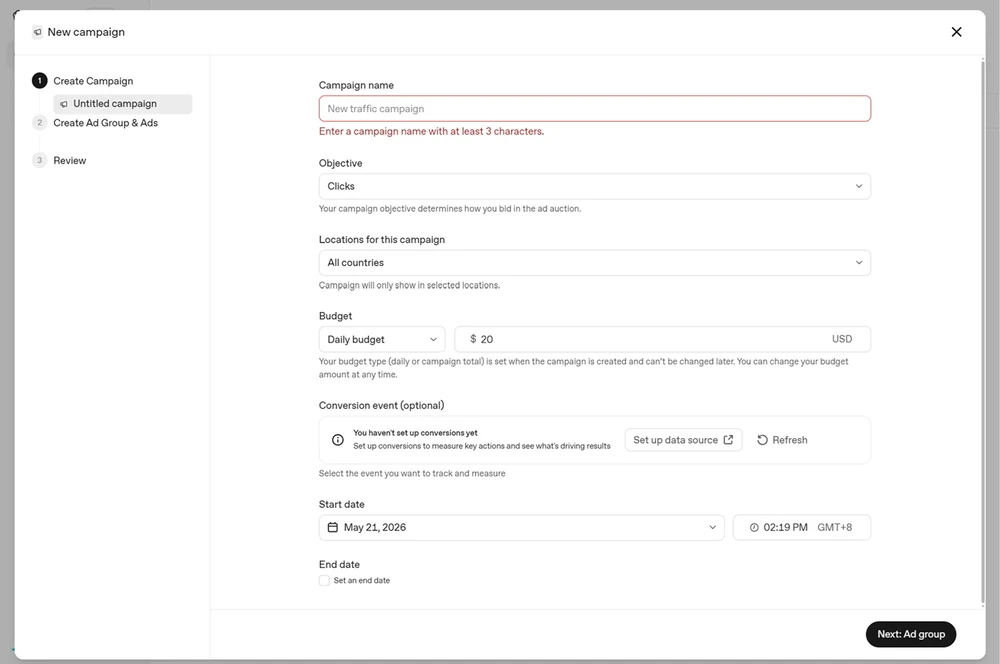
oCPC doesn’t mean you pay per conversion; billing is still per valid click. What changes is delivery, which now optimises toward the outcome you actually care about, not just the click itself. For ecommerce and lead gen advertisers, that second part pays the bills.
Product feeds and multi-product carousels
Conversion-optimised CPC now supports click-billed product feed campaigns with fixed or manual bidding and a positive conversion bid cap, meaning product ads stop being a pure traffic play. Setup is faster too: advertisers can clone an existing CPC campaign straight into oCPC, or build oCPC campaigns in bulk, with Ads Manager pre-filling the conversion event where one eligible option exists.
OpenAI is also testing a multi-product carousel format, useful for ecommerce brands with a range worth browsing.

Dynamic URL parameters and tracking updates
Dynamic URL parameters are live in Ads Manager Beta, supporting macros like {campaign_id}, {ad_group_id}, {ad_id} and {ad_account_id}, populated automatically and set at campaign, ad group or ad level. That gives clean attribution and ties ChatGPT Ads traffic back into your existing analytics stack, which matters for any channel trying to earn a permanent seat in the media mix.
You can send conversion events via the OpenAI Pixel, the Conversions API, or both for more resilient measurement, as long as you use the same event ID so events deduplicate rather than double-count.
But oCPC only optimises as well as the data feeding it. Missing or duplicated events, or a bad attribution window, skew reporting and drag down performance.
OpenAI has also added clearer Pixel diagnostics under Tools > Conversions, showing why an event was dropped, the affected field, the error type and a suggested fix, cutting the time to find and fix issues.
Automatic advanced matching (AAM)
Automatic advanced matching (AAM) is now the default for new Web pixels, and was scheduled to switch on for existing pixels from August 17, 2026 unless advertisers opted out.
AAM matches website conversions to ads when there’s no click identifier by detecting supported customer information on-site and hashing it in the browser before it’s attached to a conversion event.
While it doesn’t send raw customer data, make sure to review it against your own privacy, consent and compliance requirements before switching it on.
Triple Whale and Hightouch 3rd-party integrations
Triple Whale‘s ChatGPT Ads integration lets advertisers measure ChatGPT Ads alongside Meta, Google, TikTok and the rest of the media mix, with Sonar Optimize available to send stronger conversion signals back to OpenAI.
Hightouch is also a supported measurement partner, with its OpenAI destination piping conversion data into ad platforms. What we’re seeing is that first-party data quality is what separates channels that scale from channels that stall.
How does ChatGPT ads compare to Meta and Google Ads?
ChatGPT Ads isn’t close to Google Ads or Meta in maturity, and it’d be strange if it were. But these updates make the platform measurable enough to justify real budget. Once measurement is set up, impressions, clicks, spend, CTR, average CPC, average CPM, and conversions are all trackable. That foundation didn’t exist a year ago.
What should advertisers do now?
Don’t rush in with a big budget. Get ready instead: clean conversion tracking, an accurate product feed, landing pages that convert, analytics that can identify ChatGPT Ads traffic, and a team that knows what success looks like before launch.
Questions to ask before testing ChatGPT Ads
- Which products or services actually make sense for this channel?
- What conversion event would we optimise toward?
- Do we have enough conversion volume to learn from?
- Can we measure results properly, end to end?
- How will we compare performance against other paid channels?
- What budget gives us a fair test?
- What would we need to see before scaling further?
Need help deciding whether ChatGPT advertising should be on your roadmap?
The AI advertising space moves fast, but the fundamentals haven’t budged: clear objectives, solid tracking, useful data, sensible testing, relevant creative, an actual plan.
What makes ChatGPT Ads more interesting right now is that it’s finally measurable. If you’re already investing in paid search, paid social, shopping or ecommerce growth, it’s worth testing as the platform matures.
Search Republic can help you work out whether ChatGPT Ads makes sense for your brand, what needs to be in place before you test it, and how it fits into your wider digital strategy.
Get in touch with us for help planning your next campaign.